|
|
Research |
 | | Blended Interaction Design
(Flyer) |
| Status |
 |
 |
| Members |
 |
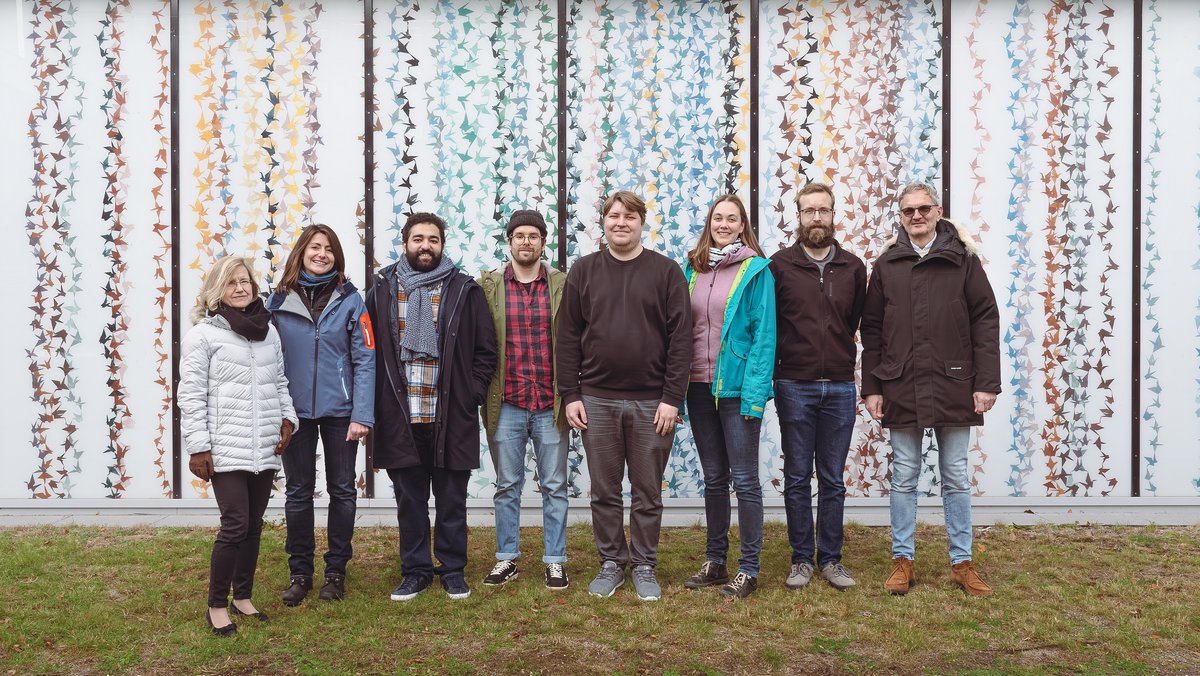
Florian Geyer, Ulrike Pfeil, Markus Hankh, Johannes Zagermann, Maximilian Ortwein, Tobias Zimmermann, Harald Reiterer |
| | | Recent blogposts |
 |
|
Honorable Mention – Best Contribution to Creative Communication Award
|
Our paper Designing Reality-Based Interfaces for Creative Group Work which we presented at the 8th ACM Creativity and Cognition Conference in Atlanta, USA was awarded with a Honorable Mention for Best Contribution to Creative Communication. Overall three papers were selected by the jury based on the following criteria: Communication, Creativity, Applicants, Design Innovation, Design for [...] [ read more]
|
|
|
|
Posted November 18th, 2011 | Posted in News
|
|
|
|
Full Paper and Award Nomination at Creativity and Cognition
|
Our group will present one full paper entitled Designing Reality-Based Interfaces for Creative Group Work at the 8th ACM Creativity and Cognition Conference that will take place at the High Museum of Art in Atlanta, USA from 3rd to 6th November 2011.We are also proud and honored that our contribution was nominated for the Best [...] [ read more]
|
|
|
|
Posted August 9th, 2011 | Posted in Event
|
|
|
|
2 full papers accepted at Mensch & Computer 2011
|
Two full papers from our group were accepted for presentation at this year’s Mensch & Computer conference. The largest german conference on Human-Computer Interaction will take place in Chemnitz, Germany from September 11th to September 14th. We will present one paper on “content-sensitive navigation in traffic control” (Inhaltssensitive Navigation in der Verkehrsleitzentrale) and one paper [...] [ read more]
|
|
|
|
Posted June 24th, 2011 | Posted in Event
|
|
|
|
|
| Description |
 |
The project Blended Interaction Design investigates novel
methods and techniques
along with computational support that seek to augment the physical, cognitive,
and social
aspects of creative interaction design activities.
MOTIVATION
Interaction design is broadly perceived as a recent trend in Human-Computer Interaction (HCI) that emphasizes on designing user experiences with technology [1,2]. Its interpretations differ between the two converging perspectives: 'Interaction design as a design discipline' and 'Interaction design as an extension of HCI' [2]. In recent years, HCI research developed methods, techniques, and tools that aim on supporting interaction designers in practice. However, due to insufficient integration, application in practice remains sparse [3]. One of the reasons for this is that interaction design research 'has not been grounded in or guided by a sufficient understanding and acceptance of the nature of design practice' [4, p.56]. Consequently, there is a growing interest in the role and nature of design in HCI research [5,6]. These contributions have already increased awareness in interaction design practice [1,7] and will influence research over time. |
RESEARCH APPROACH
In order to support design practice in HCI it is necessary to understand and describe design rationality [4], a notion that has been labeled with concepts such as the reflective practitioner [9] or the thoughtful designer [6]. More detailed descriptions and examples of disciplined behavior of designers can be found in [1,10] and [11]. These authors show that following activities, among others, are characteristic for design rationality:
- Sketching is at the core of design and is used to explore relationsships between design ideas, form and function as well as big picture and details.
- Exploring many different alternatives in a conversational way while constantly shifting focus between ill-defined problems and solutions is the prevalent work style.
- Spatial structures, like design studios and display walls make artifacts visible and provide the fundament for effective team collaboration.
- Social structures like design critique and frequent review cycles make judgements visible and are the foundation of design argumentation.
- Eventually, constant process awareness is essential to deal with the complexity of open-ended design tasks.
However, HCI struggles with integrating these 'designerly ways' [10] into practice based on several reasons:
- Because of the dynamic nature of design artifacts within interaction design - like prototype simulations or animations - computational tools are employed as powerful means of expression. However, the effort to built such artifacts often exceeds the value they have for the evaluation of design ideas.
- Due to predominant single-state document model of desktop-based software, most computational tools actually employed in practice impose a rather linear progression through design tasks [12].
- Many employed tools merely focus on the task of constructing a single design instead of supporting the messy nature of designer's explorative and spatial thinking modes [4].
- Artifacts and decisions are often buried in file systems and hide possible relations that might be valuable as part of the creative process of ideation.
- Desktop-based design tools also impose physical constraints on accessibility that makes informal creative meetings and creative collaboration awkward.
- Many of these limitations lead to a coexistence of informal artifacts like paper sketches and whiteboard drawings that are hard to archive and share but are valuable resources for design reflection and reuse.
METHOD & DESIGN PRINCIPLES
Based on the described foundations, we are designing a novel tool landscape that we call 'Blended Interaction Design'. In previous research, we gained valuable insights with 'blending' agile Software Engineering methods into HCI that we will bring into these efforts [13]. We aim to support a creative perspective on computational support for design activities.
As a first step, we explored the key features of our research domain and examined related work. Based on observational studies of design practive within interaction design courses, we decided to frame our efforts on the physical, cognitive and social aspects that we found most important.

SIMULATION
Visualizing design ideas and concepts is the integral physical activity within
interaction design that drives the design progress. While many digital tools have a focus on simulating dynamics
with prototyping tools, sketching as the central design activity is more opportunistic [1].
Overall, these different activities lead to two separate perspectives on process awareness,
shifting between problem space and solution as well as the generation of alternatives.
CREATIVITY
Informal work styles in design practice differ from work styles with desktop-based tools [12].
Most of these tools do not explicitely support divergent thinking, generation of alternatives,
and decision-making, which often leads to fixation effects [12] and undesired results.
In contrast, design techniques emphasize on the spatial nature of synthesis in design,
where juxtaposed artifacts allow reflection-in-action [9].
COLLABORATION
Interaction Design is a inherently social activity.
Therefore, it is crucial to accommodate common understanding in representations,
expressions, and feedback modalities. As desktop-based tools often bury design artifacts
and decisions in file systems, computation augmented studio settings and spatial workspaces
may provide a more practical environment for collaborative design. |
INTERACTION CONCEPTS
Based on the described principles we are designing and implementing visualization and interaction techniques based on a spatial, cross-device workspace that integrates with the physical structure of a computation-augmented design studio setting. Within our lab Media Room we are exploring various settings with interactive whiteboards, pen tablets, digital pen and paper, large high-resolution displays, and tabletops. Therefore, we combine physical interaction concepts that built upon the principles of natural interaction (e.g. tangible design artifacts) with an object-oriented zoomable user interface paradigm ZOIL [14]. By integrating informal sketching techniques and powerful design space visualizations based on a network of interconnected artifacts we will explore adequate support for collaborative creativity. Groupware features as well as techniques for communicating designs based on informal annotations will be used to facilitate co-located collaboration.
CONTRIBUTIONS
Eventually, we will assess our efforts with evaluation measures and case studies. We will draw upon feedback from the research community and our industrial partners while we seek to evaluate the physical workspace within lecture projects and class assignments.
|
This research project is funded by the German
Research Foundation
DFG (Deutsche Forschungsgemeinschaft),grant
number RE 1843/3-1 |

|
REFERENCES
| [1] |
Buxton, B.: Sketching User Experiences: Getting the Design Right and the Right Design. Morgan Kaufmann (2007) |
| [2] | Löwgren, J.: Interaction Design. from Interaction-Design.org: http://www.interaction-design.org/encyclopedia/interaction_design.html (2008) |
| [3] | Rogers, Y.: New Theoretical Approaches for HCI. Annual Review of Information, Science and Technology, Vol. 38, 1--43 (2004) |
| [4] | Stolterman, E.: The Nature of Design Practice and Implications for Interaction Design Research. International Journal of Design Vol. 2, 1, 55--65 (2008) |
| [5] |
Winograd, T., Bennett, J., De Young, L., Hartfield, B.: Bringing Design to Software Addison Wesley Professional (1996) |
| [6] | Löwgren, J., Stolterman E.: Thoughtful Interaction Design, MIT Press (2004) |
| [7] | Moggridge, B: Designing Interactions, MIT Press (2006) |
| [8] | Imaz, M., Benyon D.: Designing with Blends: Conceptual Foundations of Human Computer Interaction and Software Engineering, MIT Press (2007) |
| [9] | Schön, D. A.: The Reflective Practitioner: How Professionals Think in Action. Basic Books (1983) |
| [10] | Cross, N.: Designerly Ways of Knowing. Board of International Research in Design. Birkhäuser (2007) |
| [11] | Lawson, B.: How Designers Think, The Design Process Demystified. Architectural Press (2005) |
| [12] | Terry, M., Mynatt, E.D.: Recognizing Creative Needs in User Interface Design. Proceedings of the 4th Conference on Creativity & Cognition, 38--44 (2002) |
| [13] | Memmel, T., Geyer, F., Rinn, J., Reiterer, H.: Tool-Support for Interdisciplinary and Collaborative User Interface Specification. Proceedings of the IADIS IHCI (2008) |
| [14] |
Jetter, H., König, W. A., Gerken, J., Reiterer, H.: ZOIL - A Cross-Platform User Interface Paradigm for Personal Information Management. In CHI 2008 Workshop - The Disappearing Desktop: Personal Information Management (2008) |
|
| Publications & Theses |
 |
2011 |
Applying Embodied Cognition Theory to the Design of Collaborative Design Tools [main author webpage] [Bibtex] |
Geyer, Florian; Reiterer, Harald |
In C&C'11, ACM Creativity and Cognition Workshop: Being There, Doing it - The Challenge of Embodied Cognition for Design, Atlanta, USA, ACM Press, Nov 2011 |
@inproceedings{Geyer201116635962, author = {Florian Geyer and Harald Reiterer}, title = {Applying Embodied Cognition Theory to the Design of Collaborative Design Tools}, booktitle = {In C&C'11, ACM Creativity and Cognition Workshop: Being There, Doing it - The Challenge of Embodied Cognition for Design, Atlanta, USA}, year = {2011}, type = {inproceedings}, month = {Nov}, publisher = {ACM Press} } |
|
|  |
 |
 |
 |
Supporting methodic design practices with interactive organization and visualization of design artifacts [main author webpage] [Bibtex] |
Höchtl, Anita |
Master Thesis, University of Konstanz, Nov 2011 |
@mastersthesis{Höchtl201116654356, author = {Anita Höchtl}, title = {Supporting methodic design practices with interactive organization and visualization of design artifacts}, booktitle = {Master Thesis}, year = {2011}, type = {mastersthesis}, month = {Nov}, school = {University of Konstanz} } |
|
|  |
 |
 |
 |
Designing Reality-Based Interfaces for Creative Group Work [main author webpage] [Bibtex] |
Geyer, Florian; Pfeil, Ulrike; Höchtl, Anita; Budzinski, Jochen; Reiterer, Harald |
In C&C'11: Proceedings of the 8th ACM Conference on Creativity and Cognition, Atlanta, USA, ACM Press, Honorable Mention - Best Contribution to Creative Communication Award, p. 165-174, Nov 2011 |
@inproceedings{Geyer201116631038, author = {Florian Geyer and Ulrike Pfeil and Anita Höchtl and Jochen Budzinski and Harald Reiterer}, title = {Designing Reality-Based Interfaces for Creative Group Work}, booktitle = {In C&C'11: Proceedings of the 8th ACM Conference on Creativity and Cognition, Atlanta, USA}, year = {2011}, pages = {165-174}, month = {Nov}, publisher = {ACM Press} } |
|
|  |
 |
 |
 |
Human-Computer Interaction Group: University of Konstanz, Germany [main author webpage] [Bibtex] |
Reiterer, Harald |
ACM Press, interactions, Day in the Lab, New York, p. 82-85, Nov 2011 |
@article{Reiterer201116661892, author = {Harald Reiterer}, title = {Human-Computer Interaction Group: University of Konstanz, Germany}, year = {2011}, journal = {interactions, Day in the Lab}, volume = {18}, number = {6}, pages = {82-85}, month = {Nov}, publisher = {ACM Press} } |
|
|  |
 |
 |
 |
Ein hybrider Ansatz zur Unterstützung kollaborativer Designtechniken [main author webpage] [Bibtex] |
Geyer, Florian; Pfeil, Ulrike; Höchtl, Anita; Budzinski, Jochen; Reiterer, Harald |
In Proceedings of Mensch & Computer 2011 - Übermedien Übermorgen, Chemnitz, Germany, Oldenbourg, p. 231-240, Sep 2011 |
@inproceedings{Geyer201116627558, author = {Florian Geyer and Ulrike Pfeil and Anita Höchtl and Jochen Budzinski and Harald Reiterer}, title = {Ein hybrider Ansatz zur Unterstützung kollaborativer Designtechniken}, booktitle = {In Proceedings of Mensch & Computer 2011 - Übermedien Übermorgen, Chemnitz, Germany}, year = {2011}, pages = {231-240}, month = {Sep}, publisher = {Oldenbourg} } |
|
|  |
 |
 |
 |
AffinityTable - A Hybrid Surface for Supporting Affinity Diagramming [main author webpage] [Bibtex] |
Geyer, Florian; Pfeil, Ulrike; Budzinski, Jochen; Höchtl, Anita; Reiterer, Harald |
In INTERACT 2011: Proceedings of 13th IFIP TC13 Conference on Human-Computer Interaction, Lisbon, Portugal, Springer, p. 477-484, Sep 2011 |
@inproceedings{Geyer201116627557, author = {Florian Geyer and Ulrike Pfeil and Jochen Budzinski and Anita Höchtl and Harald Reiterer}, title = {AffinityTable - A Hybrid Surface for Supporting Affinity Diagramming}, booktitle = {In INTERACT 2011: Proceedings of 13th IFIP TC13 Conference on Human-Computer Interaction, Lisbon, Portugal}, year = {2011}, pages = {477-484}, month = {Sep}, publisher = {Springer} } |
|
|  |
 |
 |
 |
Designing Hybrid User Interfaces with Power vs. Reality Tradeoffs [main author webpage] [Bibtex] |
Geyer, Florian; Reiterer, Harald |
In Workshop Proceedings of Mensch & Computer 2011 - Übermedien Übermorgen, Chemnitz, Germany, Universitätsverlag Chemnitz, p. 43-45, Sep 2011 |
@inproceedings{Geyer201116635963, author = {Florian Geyer and Harald Reiterer}, title = {Designing Hybrid User Interfaces with Power vs. Reality Tradeoffs}, booktitle = {In Workshop Proceedings of Mensch & Computer 2011 - Übermedien Übermorgen, Chemnitz, Germany}, year = {2011}, pages = {43-45}, month = {Sep}, publisher = {Universitätsverlag Chemnitz} } |
|
|  |
 |
 |
 |
2010 |
Digital Tools for Supporting Collaborative Activities in Design Processes [main author webpage] [Bibtex] |
Geyer, Florian |
PhD Dissertation Proposal, University of Konstanz, Germany, Nov 2010 |
@unpublished{Geyer201016587914, author = {Florian Geyer}, title = {Digital Tools for Supporting Collaborative Activities in Design Processes}, booktitle = {PhD Dissertation Proposal}, year = {2010}, month = {Nov}, publisher = {University of Konstanz}, note = {PhD Dissertation Proposal} } |
|
|  |
 |
 |
 |
Supporting Creativity Workshops with Interactive Tabletops and Digital Pen and Paper [main author webpage] [Bibtex] |
Geyer, Florian; Klinkhammer, Daniel; Reiterer, Harald |
In Proceedings of ITS 2010: The ACM International Conference on Interactive Tabletops and Surfaces 2010, Poster Session, Saarbrücken, Germany, ACM Press, p. 261-262, Nov 2010 |
@inproceedings{Geyer201016570803, author = {Florian Geyer and Daniel Klinkhammer and Harald Reiterer}, title = {Supporting Creativity Workshops with Interactive Tabletops and Digital Pen and Paper}, booktitle = {In Proceedings of ITS 2010: The ACM International Conference on Interactive Tabletops and Surfaces 2010, Poster Session, Saarbrücken, Germany}, year = {2010}, pages = {261-262}, month = {Nov}, publisher = {ACM Press} } |
|
|  |
 |
 |
 |
Collaborative Sketching with Distributed Displays and Multimodal Interfaces [main author webpage] [Bibtex] |
Geyer, Florian; Jetter, Hans-Christian; Pfeil, Ulrike; Reiterer, Harald |
In Proceedings of ITS 2010: The ACM International Conference on Interactive Tabletops and Surfaces 2010, Poster Session, Saarbrücken, Germany, ACM Press, p. 259-260, Nov 2010 |
@inproceedings{Geyer201016570802, author = {Florian Geyer and Hans-Christian Jetter and Ulrike Pfeil and Harald Reiterer}, title = {Collaborative Sketching with Distributed Displays and Multimodal Interfaces}, booktitle = {In Proceedings of ITS 2010: The ACM International Conference on Interactive Tabletops and Surfaces 2010, Poster Session, Saarbrücken, Germany}, year = {2010}, type = {inproceedings}, pages = {259-260}, month = {Nov}, publisher = {ACM Press} } |
|
|  |
 |
 |
 |
Interactive User Interface Specifications – Supporting Collaboration and Creativity with Simulation-Driven Modelling Tools [main author webpage] [Bibtex] |
Geyer, Florian; Memmel, Thomas; Reiterer, Harald |
in: Pedro Isaías, IADIS Press, IADIS International Journal on WWW/Internet, p. 63-79, Aug 2010 |
@article{Geyer201016562111, author = {Florian Geyer and Thomas Memmel and Harald Reiterer}, title = {Interactive User Interface Specifications – Supporting Collaboration and Creativity with Simulation-Driven Modelling Tools}, year = {2010}, journal = { IADIS International Journal on WWW/Internet}, volume = {6}, number = {2}, pages = {63-79}, month = {Aug}, publisher = {IADIS Press} } |
|
|  |
 |
 |
 |
A Cross-Device Spatial Workspace Supporting Artifact-Mediated Collaboration in Interaction Design [main author webpage] [Bibtex] |
Geyer, Florian; Reiterer, Harald |
CHI 2010 Extended Abstracts on Human Factors in Computing Systems, Work-In-Progress Session, ACM Press, Atlanta, USA, p. 3787 - 3792, Apr 2010 |
@inproceedings{Geyer201016486743, author = {Florian Geyer and Harald Reiterer}, title = {A Cross-Device Spatial Workspace Supporting Artifact-Mediated Collaboration in Interaction Design}, booktitle = {CHI 2010 Extended Abstracts on Human Factors in Computing Systems, Work-In-Progress Session}, year = {2010}, type = {inproceedings}, pages = {3787 - 3792}, month = {Apr}, publisher = {ACM Press} } |
|
|  |
 |
 |
 |
A Cross-Device Spatial Workspace for Artifact-mediated Collaboration [main author webpage] [Bibtex] |
Geyer, Florian; Reiterer, Harald |
CHI 2010 Workshop - Artifacts in Design: Representation, Ideation, and Process, Atlanta, USA, Apr 2010 |
@inproceedings{Geyer201016486744, author = {Florian Geyer and Harald Reiterer}, title = {A Cross-Device Spatial Workspace for Artifact-mediated Collaboration}, booktitle = {CHI 2010 Workshop - Artifacts in Design: Representation, Ideation, and Process}, year = {2010}, type = {inproceedings}, month = {Apr} } |
|
|  |
 |
 |
 |
2009 |
Hybrid Affinity Diagram Manager - Eine Lösung zur digitalen Integration von Stift und Papier in kollaborativ kreatives Arbeiten [Bibtex] |
Biörnstad, Benjamin |
Bachelor Thesis, University of Konstanz, Sep 2009 |
@bachelorsthesis{Biörnstad200916422823, author = {Benjamin Biörnstad}, title = {Hybrid Affinity Diagram Manager - Eine Lösung zur digitalen Integration von Stift und Papier in kollaborativ kreatives Arbeiten}, booktitle = {Bachelor Thesis}, year = {2009}, type = {bachelorsthesis}, month = {Sep}, school = {University of Konstanz}, publisher = {University of Konstanz} } |
|
|  |
 |
 |
 |
Blended Interaction Design: A Spatial Workspace Supporting HCI and Design Practice [main author webpage] [Bibtex] |
Geyer, Florian |
Interact 2009: Proceedings of the 12th IFIP Conference on Human-Computer Interaction, Doctoral Consortium, Springer, Uppsala, Sweden, p. 844-847, Aug 2009 |
@inproceedings{Geyer200916399743, author = {Florian Geyer}, title = {Blended Interaction Design: A Spatial Workspace Supporting HCI and Design Practice}, booktitle = {Interact 2009: Proceedings of the 12th IFIP Conference on Human-Computer Interaction, Doctoral Consortium}, year = {2009}, type = {inproceedings}, pages = {844-847}, month = {Aug}, publisher = {Springer} } |
|
|  |
 |
 |
 |
|
|
|
|
|